Economic substantiation of use of sodium hipochlorite for water treatment of swimming pools
A. Istoshin
Introduction
At an estimation of a degree of risk to health of the person the most important
role is played with microbiological pollution of water. Receipt in a swimming
pool of microbes and pathogenic bacteria occurs owing to poor quality of
processing of water at stations of the centralized water-preparation, pollution
of basin occurs from visitors during operation. Water of poor quality can cause
a number of illnesses, especially if the head of the swimmer is often diped:
adenoviral pharingo-conjunctival a fever, an epidermophitia (« an itch of
swimmers»), virus hepatites A and many other things.
For exception of probability of occurrence of flashes of infectious diseases
water of basin it is necessary to subject disinfection.
Earlier, in processes of disinfection of water, chlorine-gas was used. Now this
method is not used owing to weighable restrictions on safety.
Now, to a problem of disinfection of water of basins are applied:
- the various chemical combinations, allowing to obtain disinfecting agents at
disolution in water;
- disinfection by dioxide of chlorine (ClO2), obtained from sodium
chlorite (NaClO2);
- Disinfection by sodium hipochlorite (NaClO), obtained electrolysis of chloride
of sodium (NaCl).
For definition of investment appeal of offered technology of disinfection of
water by electrolytic sodium hipochlorite it is necessary to carry out
comparison of cost of water treatment of basin of unit volume (for example,
volume 2000 м3), the methods listed above.
Hygienic requirements to quality of water of swimming pools
According to recommendations of standards of the various countries residual concentration of active chlorine in water of a swimming pool not should to exceed 3 mg/litres (tabl.1).
Table 1
|
Reagent |
Concentration of a reagent in basin, mg/l |
|||||
|
UK a, |
EC b |
USAC |
Germany d |
Italy e |
Russia f |
|
|
Active chlorine |
1-2 |
1-3 |
1-3 |
0.3-0.6 |
0.6-1.2 |
0.3-0.5 |
The note: a PWTAG (1999), b Recommended European Community values; PWTAG (1999), c American National Standards Institute (1991), d Deutsches Institut fur Normung (1997), e Gazzetta Ufficiale della Repubblica Italiana (1992), fSanPIN 2.1.2.1188-03 (2003).
The technical and economic analysis of disinfection of
water of pools
According to the data presented in table 1 concentration sodium hipochlorite in
water of a swimming pool should not exceed 3 mg/litres. Thus, for disinfection
of water of pool (from medium dirtiness of water
organic compounds) volume 2000 м3 6 kg/day of sodium hipochlorite
(2,0 kg/day of dioxide of chlorine - is required smaller concentration) is
required.
Annual charges on disinfecting of water include: amortisation charges and
working costs on: the electric power, reagents, replacement of materials.
Amortization also includes charges on repair, rent and the maintenance of a
premise, a payment on service of installation, taxes and the other fixed charges
which depend only on productivity of installation. This kind of expenses is
difficult for estimating in advance as they basically depend on an external
environment of installation on the yielded concrete place, therefore these
expenses are not included in calculation.
In table 2 expenses for disinfection of water of pool,
by volume 2000 м3, various methods are presented.
Table 2
|
Reagent/Producer |
Expenses, HUF |
|||||
|
Equipment |
Reagents (on kg) |
Electricity (on kg.) |
Service (Year) |
Disinfection 2000 m3/day (in view of all expenses) |
Disinfection 2000 m3/year |
|
|
Reagent/ http://www.pooldeals.com
|
1 000 000 |
3590 |
no |
no |
25000 |
9 125 000 |
|
Dioxide of chlorine/Bello Zone |
5 500 000 |
3200 |
no |
no |
21500 |
7 847 500 |
|
Sodium hipochlorite / Szelena2 Bt |
3 800 000 |
150 |
150 |
1 000 000 |
12500 |
4 562 500 |
Summing up the review of the market of technologies of
systems of water-preparation, it is possible to draw a conclusion - application
of the concentrated reagents and dioxide of chlorine for disinfection of water
of pools is poorly perspective, as expenses for
processing of water (for the first year of operation) in 2,0 and 1,72 times
above, than in case of use of electrolytic sodium hipochlorite.
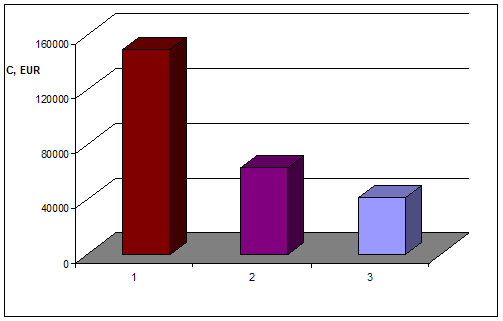
On fig. 1 expenses (in euro) on disinfection of water of pool
in volume 2000 м3 for five years of operation are presented.
Fig. 1 Expense for disinfection of water of pool in
volume 2000 м3 for five years of operation: 1 - chemical reagents, 2
- Bello Zone, 3 - Szelena2 Bt.
